What Canal Frontage Actually Buys You in Siesta Isles
August 6, 2026
August 6, 2026
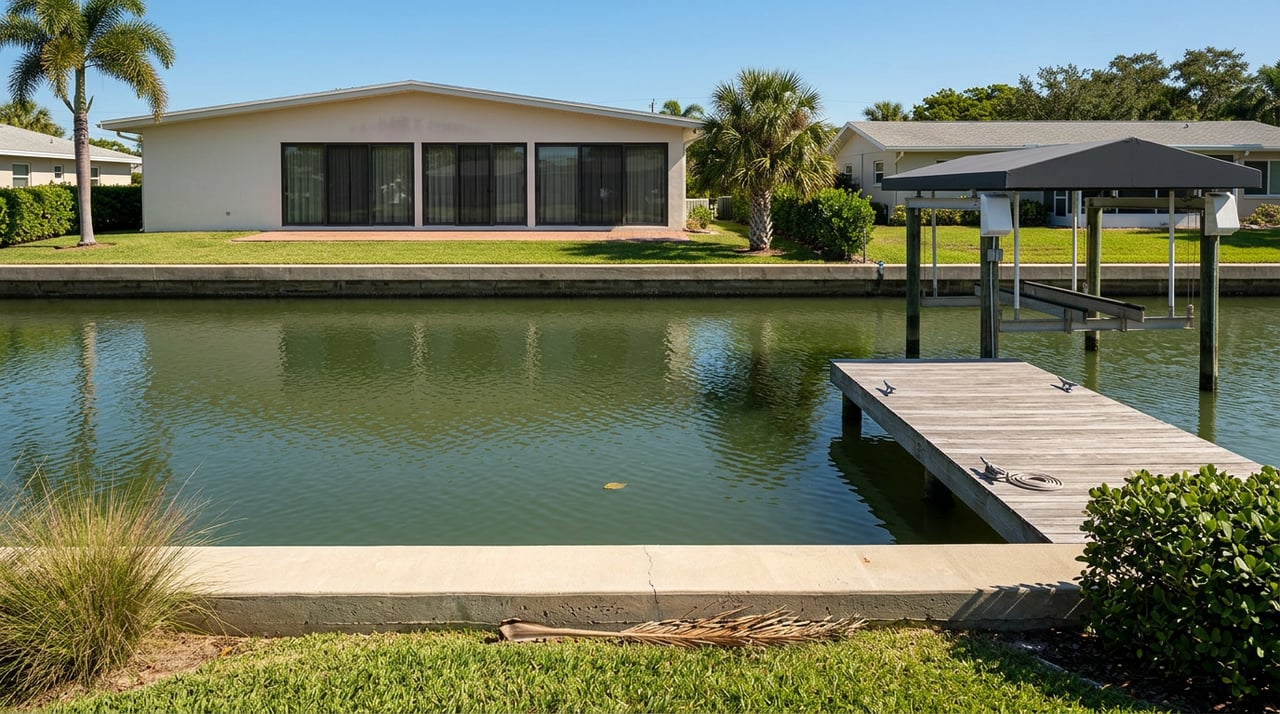
Two 1970s ranch homes sit three doors apart on the same Siesta Isles cul-de-sac. Same lot size, same square footage, similar interior condition. One trades in the low $1 millions. The other clears close to $2 million. The difference isn't the house. It's the ten feet of water immediately in front of it, and how that water connects to everything beyond.
That gap is the whole story of buying here, and it's the part the median sale price is structurally unable to tell you.
If you've been watching Siesta Key from a spreadsheet, you already know the headline. Redfin put the three-month median at roughly $899,000 through May 2026, down about 12.6% year over year, with homes moving in around 50 days. Zillow's index has the average Siesta Key value near $825,000 as of mid-2026. Broker weekly reports from July 2026 still peg barrier-island medians closer to $950K on the single-family side.
Those numbers are directionally useful and structurally misleading for Siesta Isles specifically. The neighborhood is roughly 300 single-family homes on 185 acres, threaded by about four miles of dredged canals that connect to Roberts Bay and out to the Intracoastal Waterway. Roughly half of the sales in any given cycle are waterfront. The other half aren't. Combining them into one median produces a number that describes neither group.
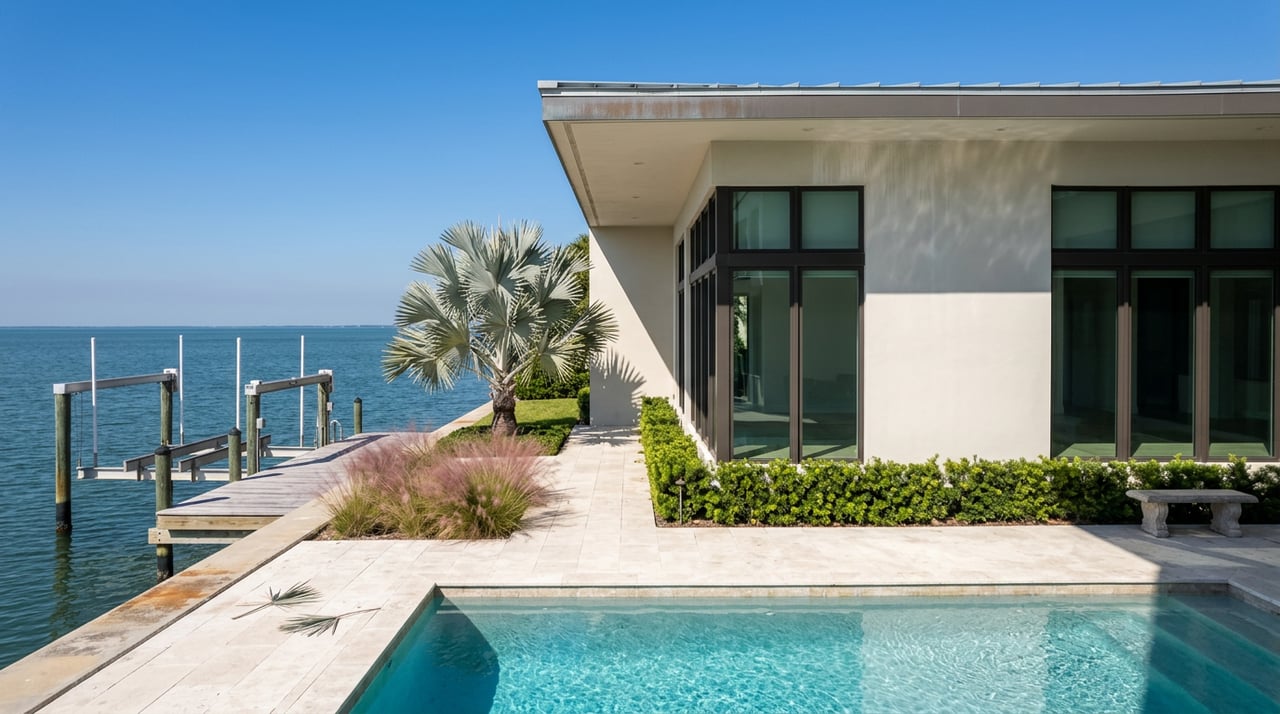
The Grand Canal is priced as a boating asset, not as a view. What the market pays for is the specific combination of depth, bridge clearance, and turn-around room in front of a given seawall. Move the same house two lots over and the value moves with it.
The selling point you'll see repeated across island marketing is that the Grand Canal system reaches open water with only one fixed bridge in the route. That's true, and it's genuinely valuable. The Siesta Key Bascule Bridge on State Road 758 opens on a schedule for taller vessels and offers a closed vertical clearance of about 25 feet, with a horizontal clearance of 90 feet in the center span. If your boat fits under closed, you never wait. If it doesn't, you plan around openings.
Here's the mechanism buyers miss. The Grand Canal is an enclosed system with essentially one entrance and exit, and per the Siesta Key Association's Grand Canal Regeneration project, it's approximately 89 acres and about nine miles of interconnected waterway, longer than Phillippi Creek. That single-entrance geometry means two things at closing:
A 27-foot center console can trigger a permitting fight with adjacent owners, as one Lotus Lane petitioner learned when the Sarasota County Commission unanimously denied a dock and lift request after neighbors argued the vessel was too large for the segment. Because these canals are man-made, riparian rights don't automatically extend the way they would on natural water. That's a friction point most portals will never surface.
Not every Siesta Isles canal parcel is the same asset. Studies going back to New College professor John Morrill's 1974 work described the Grand Canal as a maze of dead-end finger canals with sluggish circulation and stormwater inputs, and the SKA is currently addressing that with mini-reef installations in dead-end segments. As of the last public tally, 201 mini reefs had been placed inside the Grand Canal and another 42 in adjacent waterways, with two grants funding concentrated installations in problem coves.
Translation for a buyer:
| Canal position | What you actually get | What shows up in due diligence |
|---|---|---|
| Wide segment of the Grand Canal | Room to turn a 30-foot-plus vessel, better flushing | Highest per-foot frontage pricing, competitive bidding on new construction lots |
| Corner or T-intersection | Longer sight lines, easier ingress for guests' boats | Premium over interior canal, watch for wake exposure |
| Interior straight run | Standard canal frontage, most common resale | Median-adjacent pricing, seawall condition swings the deal |
| Dead-end finger | Quietest water, easiest kids-and-kayaks setup | Water-quality questions, more likely to benefit from the SKA mini-reef program, potential for stormwater outfall at the end |
| Non-waterfront interior lot | Walk or bike to beach and Siesta Key Village, larger buildable footprint per dollar | Priced against inland Siesta Key comps, not against canal comps |
Cul-de-sac frontage tends to trade for a premium inside Siesta Isles, and current MLS activity shows this at work. Recent and pending offerings on the neighborhood's stretch of the Grand Canal include Nutter Custom Construction's Marlin Model completed in 2023 on wide-canal frontage, a Tidewater Builders custom currently under construction, and a Salt Wave Construction canal-front build a walk from the village. On the other end of the spectrum, several actives are effectively land plays with 118 to 123 feet of seawall on oversized 12,000-plus square foot lots, priced for the buyer whose real product is the tear-down.
If you take one operational fact into a Siesta Isles walkthrough, take this one. Recent Sarasota and Manatee cost estimates put routine seawall repairs at roughly $25 to $125 per linear foot, and full replacement at $500 to $1,200 per linear foot. On a 150-foot wall, a full replacement runs $75,000 to $180,000. A single-panel failure caught late can be a $60,000 repair that started as a $2,000 crack.
Two implications for how you write your offer:
Insurance and lending underwriters now treat seawall condition as a first-order question in VE and AE flood zones, and Siesta Key has both. Carriers have declined to bind coverage on failing walls. That's a financing risk, not just a maintenance question, and it moves through to appraisal.
Older Siesta Isles homes were largely built between the late 1950s and 1970s, and a well-built concrete seawall lasts roughly 40 to 50 years under maintenance. Do the math on a 1968 build with an original wall and no documented panel replacements. On a canal-front purchase, ask for the seawall inspection before you argue about the kitchen.
The neighborhood is currently trading in two distinct product categories, and lumping them together is why the "Siesta Key median" number rarely matches what you actually see on tours.
Category one: new or recently renovated waterfront. These are the Marlin Model, the current Tidewater and Salt Wave builds, and homes that have already absorbed the seawall, dock, lift, and elevation costs. They compete against Longboat Key and Bird Key rebuilds and price accordingly. County-wide luxury data from the week of July 26 to August 1, 2026 showed a $1.625 million median across 37 closings at $1M-plus, with average marketing times around 122 days. The upper tier moves slower and rewards patience on both sides.
Category two: original-condition waterfront on prime lots. These are pricing close to lot value, because a rational buyer models the acquisition as land plus $1.5 to $3 million of new construction. Sarasota County single-family homes overall in the same July 26 to August 1 window closed at a $510,000 median and 72 days on market. Siesta Isles teardowns don't play in that market. They play in the land market, and the pricing signal is frontage feet, canal position, and seawall status.
If you're pricing an offer off the neighborhood's blended median, you'll misread both ends of the spectrum. New construction feels overpriced until you subtract land, permits, and 14 to 18 months of build cycle. Original-condition waterfront feels overpriced until you accept that you're not buying the house.
Three practical shifts:
How does Siesta Isles compare to Bay Island on the water? Bay Island shares a similar canal-and-bay setting and generally trades on comparable frontage economics. The differentiator is often bridge clearance and specific canal geometry, not the subdivision label.
Is a dead-end canal a problem or an opportunity? It depends on your use. Dead-end segments are calmer and safer for small children and paddle craft. They also have documented water-flow issues that the SKA is actively addressing with mini-reef installations. If you're buying to fish and cruise, a flow-through segment is worth the premium. If you're buying for a quiet dock and kayaks, the discount can be real.
Does the current buyer's market help here? Directionally yes, with a caveat. Barrier-island medians have softened and days on market have lengthened at the top of the market. Well-positioned, well-maintained waterfront in Siesta Isles is still a scarcity asset, so negotiation room is real on the land plays and thinner on the turnkey new builds.
If you're weighing a canal-front purchase in Siesta Isles, the mechanics of the specific parcel matter more than any island-wide statistic you'll read. Michelle Shiver and the Sarasota Luxury Home Team walk this neighborhood in person, know which canal segments are trading at a premium this quarter, and can pair you with the marine surveyors and seawall contractors whose reports actually hold up in negotiation. Schedule a private consultation to start the conversation.
Stay up to date on the latest real estate trends.

Real Estate, Gulf Coast of Florida
How discreet buyer representation, nondisclosure agreements and early legal planning can help protect your privacy.

Real Estate, Gulf Coast of Florida
Three Sarasota barrier islands. Three distinctly different lifestyles.

Real Estate, Gulf Coast of Florida
Before you fall in love with the view, take a good look at the association.

We’d love to hear from you! Whether you’re buying, selling, or just exploring your options, we're here to provide answers, insights, and the support you need. Contact us and start planning your next move.
1549 Ringling Blvd Ste 600 Sarasota, FL 34236